PSA Grading Guide for Australian Collectors 2026
By Reece Conway — 2026-05-11 · 10 min read
Everything you need to know about PSA grading in Australia — the 1–10 scale explained, how to submit, real Australian costs, turnaround times, PSA vs BGS, and exactly which cards are worth sending in.
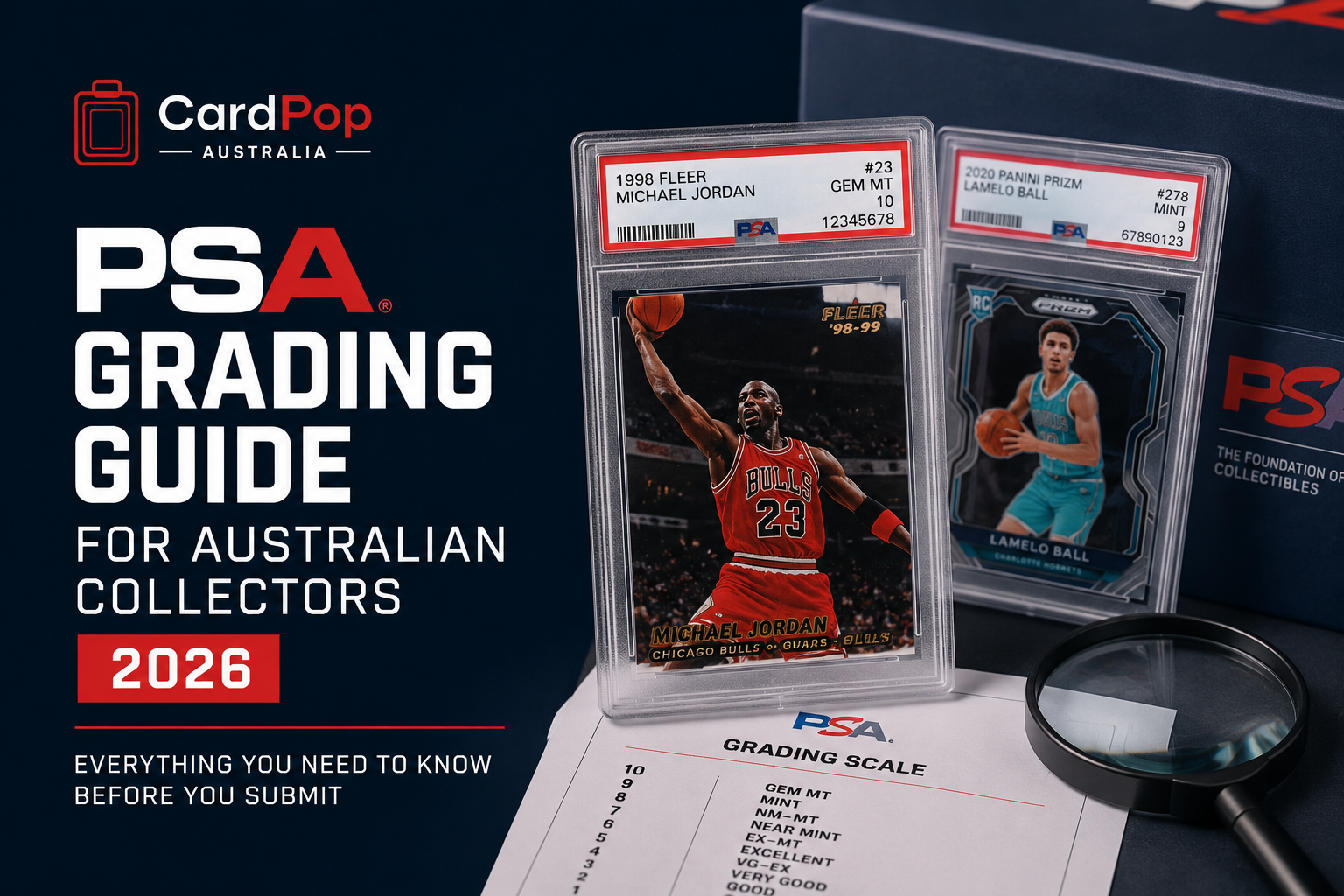
PSA grading is the dominant authentication standard for trading cards in Australia, commanding premium resale prices across sports cards, Pokémon, and TCG. The 1–10 scale is simple in theory but consequential in practice: the gap between PSA 9 and PSA 10 represents a 4–10× value difference that determines whether grading is financially worthwhile.
As of May 2026, direct PSA submissions from Australia are suspended due to US tariff changes. Australian dealers—led by The Hobby Australia, Card Bot, Mana Market, Slabd, and One Stop Poke Shop—are the only submission route. Economy grading runs approximately AUD $68 per card with a ~95 business day turnaround at PSA.
For most modern cards under AUD $100 raw value, grading destroys value after fees. For high-grade rookies, chase parallels, and vintage cards, the economics are compelling. This guide gives Australian collectors the framework to make that call accurately.
- PSA 9 (Mint) is the most targeted grade for Australian collectors — strong resale, achievable for well-stored modern cards
- Only 2–5% of modern cards submitted achieve PSA 10; the value premium is 4–10× over PSA 9
- Direct PSA submissions from Australia are suspended as of May 2026 — use an Australian dealer
- Economy grading costs approximately AUD $68 per card (~95 business days) through local dealers
- Grading destroys value for modern base cards under AUD $100 raw after the 2026 PSA fee increase
- The four factors PSA grades on: centering, corners, edges, surface — in that order of importance
- PSA dominates Australian resale for sports cards; CGC is gaining ground for Pokémon
- Inspect every card under a 10× loupe before submitting — if you can see flaws, PSA will too
If you’ve spent any time in the Australian card hobby, you already know what a PSA slab looks like. That red-labelled plastic case has become the universal signal for “this card is legitimate, graded, and ready to trade.” But understanding what the number on the label actually means — and whether your card is worth the cost and wait to get one — is a different question entirely.
This guide covers everything an Australian collector needs: the full PSA grading scale explained in plain English, the four criteria PSA uses to assess every card, a realistic look at Australian submission options and costs, and an honest framework for deciding when grading is actually worth it.
💡 The Key Numbers
PSA 9 and PSA 10 are where the value is. 90% of modern cards submitted to PSA grade at PSA 8 or higher. Only 2–5% achieve PSA 10. Note: PSA raised fees in February 2026 — Economy now starts at USD $32.99 direct (AUD ~$68 via AU dealers). The jump from PSA 9 to PSA 10 is the biggest value cliff in the hobby.
35M+
Cards graded by PSA since 2018
2–5%
Modern cards that achieve PSA 10
4–10×
PSA 10 vs PSA 9 value multiplier
AUD $68+
Economy grading fee via AU dealers (2026)
The PSA Grading Scale: 1–10 Explained
PSA uses a 1–10 whole-number scale — no half points, no PSA 9.5. That single gap between 9 and 10 is the most consequential jump in the hobby. Here’s what every grade actually means:
GEM MINT
The gold standard
Centering: 55/45 front • 75/25 back
MINT
The sweet spot
Centering: 60/40 front • 90/10 back
NM–MT
Near Mint-Mint
Centering: 65/35 front • 90/10 back
NEAR MINT
NM
Centering: 70/30 front • 90/10 back
EX–MT
Excellent-Mint
Centering: 80/20 front • 90/10 back
EXCELLENT
EX
Centering: 85/15 front • 90/10 back
VG–EX
Very Good-Excellent
Centering: 85/15 front • 90/10 back
VG / GOOD / POOR
Collector / vintage grades
Centering: 90/10 minimum for grades 2–3
The PSA 9–to–10 Cliff: Why It Matters
There is no PSA 9.5. PSA introduced half-grades up to 8.5 in 2008 but deliberately stopped there — keeping the 9-to-10 jump as a binary: your card either reaches perfection or it doesn’t. This creates the most extreme value gap in the hobby:
| Card | Raw | PSA 8 | PSA 9 | PSA 10 |
|---|---|---|---|---|
| Wemby 2023 Topps Chrome RC | ~$30 | ~$80 | ~$170 | ~$600+ |
| LeBron 2003–04 Topps Chrome #111 | ~$800 | ~$3,300 | ~$3,600+ | ~$17,000+ |
| Cooper Flagg 2025–26 Topps Chrome RC | ~$12 | ~$40 | ~$170 | ~$900+ |
All prices in AUD. Based on recent eBay.com.au sold listings, May 2026.
The Four Factors PSA Grades Every Card On
Every card PSA receives is assessed on exactly four criteria. Understanding these is the key to predicting your grade before you submit — and to inspecting cards you’re buying.
⚖️
1. Centering
The most common reason cards don’t reach PSA 10. Measured as a border ratio — PSA 10 requires 55/45 or better on the front. Even 56/44 technically fails. Check centering front, back, and both axes before submitting. Hold the card up to a light source and use a ruler if unsure.
📐
2. Corners
Inspected under magnification. Even microscopic fuzzing or rounding visible under a 10× loupe can drop a card from PSA 10 to PSA 9. Touch-cap damage from handling alone is a common culprit. Always sleeve cards immediately after removing from packs. Never touch corners.
✂️
3. Edges
Look for chipping, fraying, and rough factory cuts. Whitening on dark-bordered cards is a major grade killer — especially common on Topps Chrome and Prizm cards with dark borders. Edge chipping often happens during shipping if cards aren’t packed correctly.
🔍
4. Surface
Scratches, print lines, stains, and loss of original gloss. Surface issues are often invisible until light hits the card at an angle. Use a single light source held at 30–45 degrees and slowly rotate the card — any surface defects will catch the light.
💡 Pro tip: The 10× loupe test
Before submitting any card, inspect it under a 10× jeweller’s loupe. If you can see corner wear, edge chips, or surface scratches under 10× magnification, PSA’s graders will too. A $20 loupe from a camera shop will save you from expensive PSA 8 surprises.
Is PSA Grading Worth It? The Australian Collector’s Framework
This is the most important question in grading, and most guides avoid answering it honestly. Here’s the truth: for most cards, grading destroys value. Grading fees plus wait time only make sense when the maths works in your favour.
The Simple Grading Maths
| Scenario | Verdict | Why |
|---|---|---|
| Modern rookie likely to PSA 10 (Wemby, Flagg) | ✓ Grade it | PSA 10 multiplier is 4–10× — economics work even with AUD $68+ fee |
| High-value vintage (pre-1990) in any grade | ✓ Grade it | Authentication alone adds value; vintage scarcity = grade premium |
| Pokémon SIR/SAR chase card likely PSA 9+ | ✓ Grade it | Strong TCG community demand for slabbed Pokémon in Australia |
| Numbered parallel (/99 or lower) in PSA 9+ condition | ✓ Grade it | Scarcity × grade = strong premium; highly liquid in AU market |
| Modern base card under AUD $100 raw | ✗ Don’t grade | AUD $68+ fee erases PSA 9 premium after Feb 2026 price rise |
| Card likely to grade PSA 8 (noticeable corner wear) | ✗ Don’t grade | PSA 8 often sells for less than raw equivalent after fees |
| One Piece alt art chase card (Luffy, Zoro, Law) | ⚠ Check pop | Growing TCG grading demand but check population report first |
⚠️ The upcharge risk
If your card grades higher than the declared value tier you submitted in, PSA charges the higher tier fee. Always declare conservatively and check recent PSA 10 sales before submitting — an unexpected upcharge can blow out your per-card economics.
How to Submit Cards for PSA Grading: Step by Step
There are two ways to submit to PSA from Australia: directly through PSA’s own portal, or through an Australian dealer. As of May 2026, direct PSA submissions from Australia are temporarily suspended — Australian dealers are currently the only route.
Option 1: Submit Through an Australian PSA Dealer (Recommended)
- Choose your dealer — see the full comparison below. The Hobby Australia is the only PSA Certified Dealer in the Southern Hemisphere; Card Bot and Mana Market are popular alternatives.
- Prepare your cards — place each card in a clear soft sleeve inside a Card Saver I semi-rigid holder. Never use top loaders (too thick) or opaque/matte sleeves. Cards over 130pt thickness can use a top loader.
- Complete the submission form — for each card you need: Year, Manufacturer, Set, Player/Character, Card number, Parallel (if applicable), and your estimated grade. Use eBay sold listings to find the declared value.
- Declare value accurately — this determines your fee tier and your insurance coverage if the card is lost. Be conservative but realistic. PSA can upcharge if the final grade value significantly exceeds your declaration.
- Submit and pay — most Australian dealers require payment upfront or on return. Insured return shipping is typically included.
- Track your submission — PSA provides a unique submission number. All Australian dealers provide tracking updates as cards move through the PSA process.
- Receive your slabs — Economy tier takes approximately 95 business days at PSA plus transit. Verify grades at psacard.com/cert using your certification number.
Option 2: Submit Directly Through PSA
⚠️ Important update — May 2026
PSA has suspended direct international submissions from Australia due to US tariff changes. Australian dealers are currently the only submission route. Check psacard.com for updates on when international access resumes.
When direct submissions do reopen, the process involves creating a PSA account, submitting cards via psacard.com, packing cards with Card Saver I holders, and arranging your own insured international courier to PSA’s facility in Santa Ana, California. You handle all shipping, insurance, and customs yourself — which is why most Australian collectors prefer using a local dealer.
Australian PSA Submission Services: Full Comparison
Here are the most trusted Australian PSA submission services, with real fee data as of May 2026:
The Hobby Australia
PSA Certified Dealer — Point Cook, VIC · thehobby.com.au
Australia’s first and only PSA Certified Dealer in the Southern Hemisphere. Submits over 50,000 cards per year. Full insurance from submission to return. Payment made after grading is complete — no upfront payment required.
Card Bot
Melbourne + Postal · cardbot.com.au
All-inclusive pricing (GST, customs, taxes included). Melbourne drop-off available at no extra cost. Postal submissions accepted nationally. Comprehensive insurance included.
Mana Market Australia
Online · manamarket.com.au
Transparent published pricing in AUD. Submits to PSA every Tuesday. Cards tracked online via unique submission number with daily updates. Strong for Pokémon and TCG submissions.
One Stop Poke Shop
Online · onestoppokeshop.com.au
Appointment-based submission system (one booking per 15 cards). Payment required on receipt. Full insurance during transit. Strong Pokémon focus with an active community.
Slabd
Online · slabd.com.au
Slab-focused Australian submission service with a clean booking interface. All-inclusive pricing. Strong community presence and regular grading livestreams on social media.
PSA vs BGS vs CGC: Which Grading Company Should Australian Collectors Use?
There are three major grading companies relevant to Australian collectors. Here’s how they compare:
| Feature | PSA | BGS (Beckett) | CGC |
|---|---|---|---|
| Grading scale | 1–10 whole numbers only. No PSA 9.5. | 1–10 in half-point increments. BGS 9.5 is common top grade. | 1–10 whole numbers. CGC 10 Pristine is top grade. |
| Subgrades | None. Overall grade only. | 4 subgrades on slab: centering, corners, edges, surface. | None on standard. Available on Pristine tier. |
| Top grade | PSA 10 Gem Mint | BGS 10 Black Label Pristine | CGC 10 Pristine |
| AU resale value | 🏉 Highest for sports cards. Industry gold standard. | 🏊 Strong for basketball and vintage. | 🏋 Growing for Pokémon and TCG. |
| Best for | Sports cards, all modern rookies, maximum resale liquidity in AU market. | High-end cards where subgrades matter, vintage basketball. | Pokémon and TCG. Best bulk pricing. |
| AU submission | Via The Hobby, Card Bot, Mana Market, Slabd, OSPS. | Fewer local dealers. Direct submission or via The Hobby. | Direct international submission. Growing AU dealer network. |
| Verdict | Default choice for Australian sports collectors. | Use if subgrades matter or chasing a BGS 9.5/Black Label for vintage. | Use for Pokémon bulk submissions where CGC 10 Pristine premium is real. |
🇦🇺 Australian market reality
In Australia, PSA dominates. Local Facebook groups, Whatnot, and eBay.com.au buyers overwhelmingly prefer PSA slabs for sports cards. For Pokémon, both PSA and CGC have strong demand. BGS is respected but has lower local liquidity — you may need to sell on eBay USA to get full BGS premiums.
Frequently Asked Questions: PSA Grading in Australia
How much does PSA grading cost in Australia? ▼
What is the best PSA grade for an Australian collector? ▼
How do I submit cards for PSA grading in Australia? ▼
How long does PSA grading take from Australia? ▼
Is PSA grading worth it for Australian collectors? ▼
What is the difference between PSA and BGS grading? ▼
If you hold well-stored modern rookies: the PSA 9 market in Australia is deep and liquid. You don’t need PSA 10 to profit — but you need PSA 9 to reliably outperform raw. Focus on centering and corners before submitting anything.
If you’re buying graded cards: PSA 8 slabs frequently sell for the same price as raw equivalents after fees are factored in. Target PSA 9 and above for any card you expect to resell. Verify every cert at psacard.com/cert before purchasing.
For the Australian market specifically: PSA slabs are universally accepted on eBay.com.au, Whatnot Australia, and local Facebook groups. BGS premiums largely exist only on international platforms. Grade in PSA unless you have a specific reason to use BGS or CGC.
- PSA Grading Standards — psacard.com/gradingstandards
- PSA Get Started Guide (submission volumes, grade distributions) — psacard.com/info/get-started
- The Hobby Australia — PSA Certified Dealer Australia — thehobby.com.au
- Card Bot — Australian PSA Submission Service — cardbot.com.au
- Mana Market Australia — Published PSA pricing (May 2026) — manamarket.com.au
- Slabd Australia — slabd.com.au
- PSA Population Report — psacard.com/pop
- Legion Report — PSA Grading Scale History — legionreport.com
- eBay.com.au sold listings (Wemby, LeBron, Flagg PSA comps) — verified May 2026
Last updated May 2026. PSA fees and turnaround times change regularly — always confirm current pricing at psacard.com or directly with your chosen Australian dealer before submitting.