Understanding Card Parallels: The Complete Visual Guide
By Reece Conway — 2026-06-24 · 11 min read
Silver, refractor, prizm, cracked ice, gold /10, superfractor 1/1 — parallels are where card values are really made. This visual guide shows you exactly what each one looks like and how rare it is.
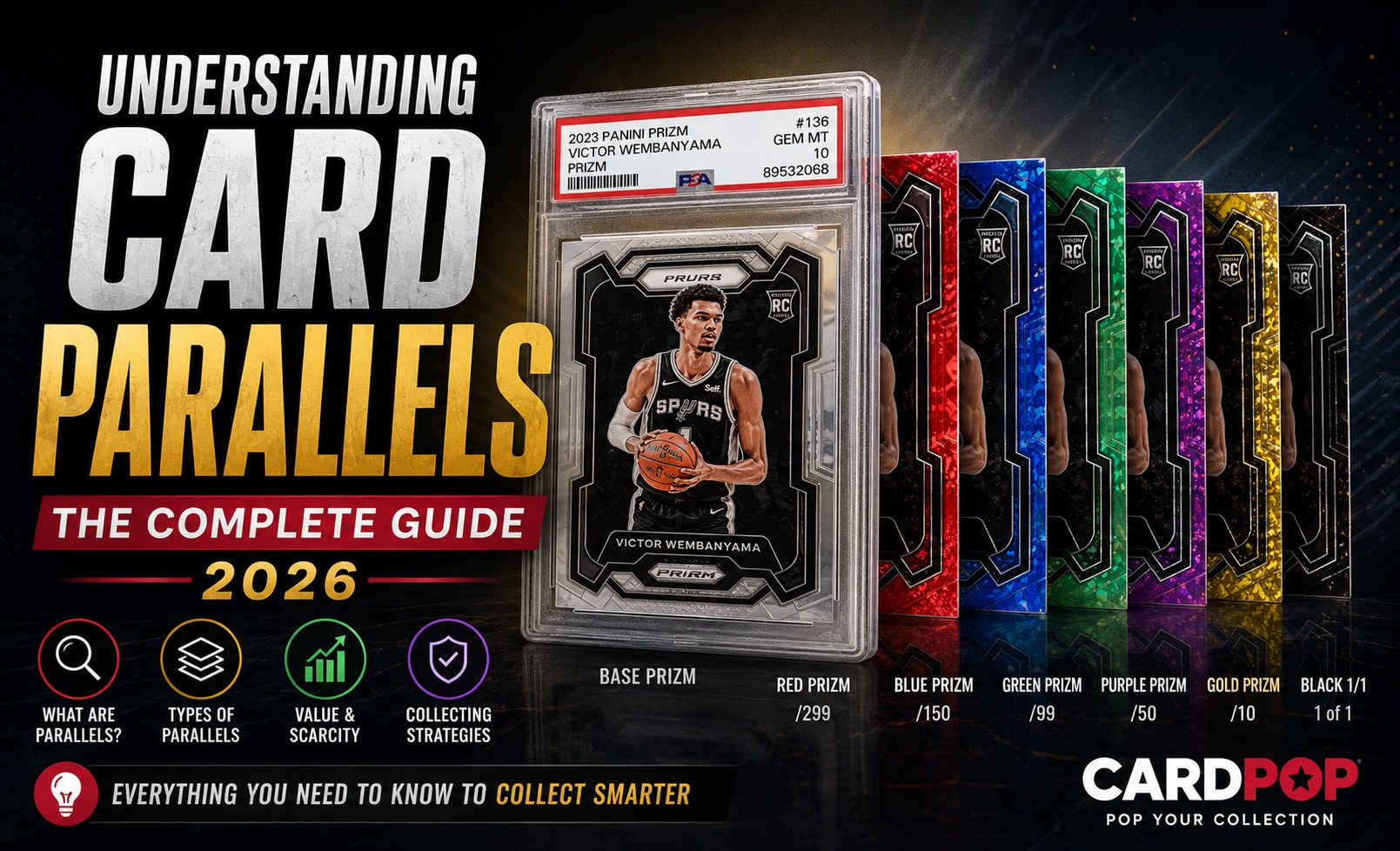
A parallel is an alternate version of a base trading card — same photo and design, but with a different foil finish, colour or serial number that makes it rarer and more valuable. Parallels are where most of the value in modern collecting is actually made, yet they are the single most confusing topic for new collectors.
The problem is that the hobby’s language is visual. Words like “Silver”, “refractor”, “cracked ice” and “superfractor” mean nothing until you actually see them. This guide fixes that. Below you will find a visual gallery showing what every major parallel finish looks like, how rare each one is, and exactly what to look for when you are buying.
By the end you will be able to look at any listing — on CardPop, eBay or anywhere else — and know precisely what you are looking at and what it should be worth.
- A parallel is the same card with a different finish, colour or serial number — rarity is the whole point
- The base “Silver” Prizm (Panini) and the “Refractor” (Topps Chrome) are the same idea — the entry-level chrome parallel that anchors a player’s market
- Colour parallels follow a rarity ladder — the lower the serial number (/99, /25, /10, /1), the scarcer and more valuable the card
- A serial number like 23/99 means your card is one of only 99 printed — numbered parallels are scarcer than most unnumbered ones
- A 1/1 (“one of one”) — Superfractor, Gold Vinyl or Black Finite — is the only copy in existence
- Finish drives value as much as the player: the same rookie can range from a few dollars raw to thousands as a numbered colour parallel
If you have spent any time around modern trading cards, you have heard the words: Silver, refractor, prizm, holo, cracked ice, mojo, gold, superfractor. They sound like jargon — and they are — but they describe something simple. Every one of them is a parallel: an alternate version of a base card.
Parallels are the engine of the modern hobby. The same rookie card can be worth a few dollars in its plain base form and thousands of dollars as a numbered colour parallel. Learning to recognise them on sight is the single highest-value skill a new collector can build — and because the difference is visual, the only way to learn it is to see it.
💡 The one-sentence definition
A parallel is the same card with a different finish, colour or serial number — printed in smaller quantities than the base, which is exactly why collectors pay more for it.
What Is a Parallel?
When a card set is released, every player has a base card — the standard, most common version. A parallel takes that exact card — same image, same player, same number on the back — and changes its appearance to make it scarcer. That change might be a shiny chrome coating, a colour tint, a textured foil pattern, or a stamped serial number capping how many were ever made.
Think of it as the same song released as a standard track, a limited vinyl pressing, and a one-off signed master. The content is identical. The scarcity — and therefore the price — is completely different.
How to Read a Parallel: The Three Signals
Every parallel communicates its rarity through three signals. Learn to scan for these and you can value almost any card at a glance.
✨
1. The Finish
The foil effect — flat base, shimmering Silver, rainbow refractor, or a textured pattern like cracked ice. The finish is the first thing your eye should catch.
🌈
2. The Colour
Coloured parallels follow a rarity ladder — red, blue, green, purple, orange, gold and beyond. Within a set, colour usually signals roughly how scarce a card is.
🔢
3. The Serial Number
A stamp like 23/99 means card 23 of only 99 made. The smaller the print run, the rarer the card. 1/1 means it is the only one in existence.
The Visual Parallel Gallery
Here is what the hobby is actually talking about. Each tile below recreates the look of a major parallel finish, with its typical scarcity and what to watch for. Rarity is shown on a five-dot scale — ● common to ●●●●● grail.
Finishes & foils
Base
Most common — unnumbered
●●●●●
Flat, matte finish. The standard version every other parallel is built from.
Silver / Refractor
Usually unnumbered
●●●●●
The chrome shimmer that anchors a player’s market. The single most important parallel to know.
Holo / Rainbow
Varies by set
●●●●●
A full rainbow shimmer that shifts under light. Eye-catching and a collector favourite.
Hyper
Unnumbered — retail
●●●●●
Bold two-tone split. A common retail-exclusive finish that is easy to spot.
Mojo
Often unnumbered
●●●●●
A bubbled, beaded sparkle pattern across the card. Flashy under direct light.
Cracked Ice
Often numbered
●●●●●
A shattered-glass texture that looks like fractured ice. Distinctive and popular.
Disco
Unnumbered — retail
●●●●●
A tight dot-matrix sparkle. A modern retail favourite with strong eye appeal.
Superfractor 1/1
One of one
●●●●●
Swirling gold foil, serial-numbered 1/1. The pinnacle — the only copy that exists.
Numbered colour parallels — the rarity ladder
Coloured parallels are usually serial-numbered, and the colour tells you roughly how rare the card is. Print runs vary between sets, but the ladder below reflects the typical pattern in flagship products like Panini Prizm.
Red
Approx. /299
●●●●●
An accessible entry into numbered parallels.
Blue
Approx. /199
●●●●●
A step scarcer than red, with strong demand.
Green
Approx. /149
●●●●●
Mid-ladder scarcity and a clean, popular look.
Purple
Approx. /99
●●●●●
The /99 tier — a genuine scarcity threshold collectors chase.
Orange
Approx. /60
●●●●●
Low double-digit print runs — clearly scarce.
Pink
Approx. /50
●●●●●
A sought-after colour with serious eye appeal.
Gold
/10
●●●●●
The /10 gold is a hobby milestone — a major step up in value.
Black 1/1
One of one
●●●●●
Black Finite and similar 1/1s sit at the very top of the ladder.
💡 A note on these visuals
The tiles above are illustrations of each finish so you can recognise the effect — real cards shimmer and shift under light in a way a flat screen cannot fully capture. Print runs differ between sets and years, so always confirm a card’s actual serial number and the specific product before buying.
The Colour & Rarity Ladder
Here is the typical numbered ladder collectors refer to. Use it as a mental model, not a hard rule — every set defines its own print runs.
| Tier | Typical print run | Relative scarcity |
|---|---|---|
| Base | Unlimited / unnumbered | Common |
| Silver / Refractor | Unnumbered, but limited | Uncommon — the market anchor |
| Red / Blue / Green | /299, /199, /149 | Scarce |
| Purple / Orange / Pink | /99, /60, /50 | Very scarce |
| Gold | /10 | Rare — major value step |
| Gold Vinyl / Black / Superfractor | /5, /1 | Grail — one-of-a-kind at 1/1 |
Prizm vs Chrome: Two Names, One Idea
One of the biggest sources of confusion is that two different manufacturers use different words for the same concept. Once you know this, half the jargon disappears.
Panini Prizm
The dominant basketball and football brand. Its base chrome parallel is the Silver Prizm, and coloured versions are called “Prizms” (Red Prizm, Gold Prizm, and so on). The 1/1 is the Black Finite.
Topps Chrome / Bowman
The dominant baseball, soccer and UFC chrome brand. Its base chrome parallel is the Refractor, with coloured refractors up the ladder. The 1/1 is the Superfractor.
The takeaway: a Silver Prizm and a base Refractor occupy the same rung — the entry-level chrome parallel that anchors a player’s market. Pokémon and Magic: The Gathering have their own equivalents too (reverse holos, full arts, etched and foil treatments), but the underlying logic is identical: the scarcer the finish, the more it is worth.
Why Parallels Drive Value
Scarcity is the whole point. A player can have tens of thousands of base cards in circulation but only ten Gold parallels and a single Superfractor. When demand for that player is high and supply is fixed at ten — or one — price discovery does the rest.
This is why two cards of the same player, same set and same photo can be worth wildly different amounts. The base might trade for the price of a coffee while the numbered colour parallel sells for hundreds or thousands. The image is the same; the scarcity is not.
Three rules parallels teach you
- Numbered beats unnumbered — a /99 is a known, fixed quantity; an unnumbered parallel is not
- Lower number, higher value — /10 is worth far more than /199 of the same card
- Condition still rules — a scarce parallel in a high PSA grade commands a premium on top of its scarcity
How to Buy Parallels Smartly
Now that you can recognise parallels, here is how to use that knowledge when you buy.
| Do | Avoid |
|---|---|
| Confirm the exact parallel and serial number in the photos | Assuming “shiny” means rare — many chrome cards are common |
| Check recent sold prices for that specific parallel | Comparing a numbered parallel to base-card prices |
| Factor in condition and grade before paying a premium | Overpaying for a low grade just because it is numbered |
| Buy the player and the moment, then the scarcest finish you can afford | Chasing every colour of one player at the expense of quality |
Ready to put it into practice? Browse numbered parallels and chrome rookies from Australian sellers on the CardPop Marketplace — a 3% fee versus eBay’s 13.4%, with no international shipping.
Frequently Asked Questions
What is a parallel card in simple terms? ▼
What does a serial number like 23/99 mean? ▼
What is the difference between a Prizm and a Refractor? ▼
Which parallel colour is the rarest? ▼
Are parallels worth more than base cards? ▼
Continue your collecting journey
The Basketball Card Collecting Bible
Everything a new collector needs before buying their first card.
The CardPop Investor’s Guide to NBA Rookie Cards 2026-27
Spot future hobby stars — and the parallels worth backing — early.
PSA Grading Guide for Australian Collectors
Costs, tiers and submission routes for grading from Australia.
Is Importing PSA Cards Worth It in Australia?
The full 2026 cost breakdown for importing graded cards.
CardPop Research Team
The CardPop Research Team tracks card finishes, parallels and grading data across the Australian hobby. The Parallel Report is CardPop’s research desk — covering the stories, trends and data shaping trading card collecting and investing. Browse the CardPop Marketplace.
- Panini America — Prizm parallel structure & print runs — paniniamerica.net
- Topps — Chrome & Bowman Refractor parallels — topps.com
- CardPop — The Basketball Card Collecting Bible (2026 Edition) — cardpop.online/blog
- eBay.com.au Sold Listings — parallel price benchmarks (2026)
Last updated June 2026. The parallel finishes shown here are illustrations of each effect, not photographs of specific cards. Print runs and parallel structures vary by set and year — always confirm the exact product and serial number before buying or selling.